Español
Español English العربية Български বাংলা Čeština Dansk Deutsch فارسی Français Ελληνικά עִבְרִית हिन्दी Magyar Italiano 日本語 한국어 Lietuvių kalba Latviešu valoda Bahasa Melayu ਪੰਜਾਬੀ Română Русский Slovenčina Српски језик Shqip Svenska Українська Türkçe اردو 香港中文 Norsk bokmål සිංහල தமிழ்
Saltar al Contenido
Logotipo de Fragile X International
  • Acerca del síndrome del cromosoma X frágil
      La condición
      • Síndrome del cromosoma X frágil
      • Los puntos fuertes del síndrome del cromosoma X frágil
      • Diagnóstico del síndrome del cromosoma X frágil
      • Terapias no médicas para el síndrome del cromosoma X frágil
      La persona
      • Ayudar a alguien con síndrome del cromosoma X frágil
      • Niñas con síndrome X frágil
      • Sexualidad
      • Autonomía y consentimiento
      la familia
      • Genética del X frágil
      • Enfermedades asociadas a la premutación del cromosoma X frágil 
      Para más información
      • Actividades de pausa con movimiento
      • PREGUNTAS FRECUENTES
      • Clínicas de X frágil por país
      • Recursos
  • Quiénes somos
    • Asociaciones familiares por país
    • Historias de familia
    • Afiliarse
    • Consejo de Administración
    • Consejo Asesor
  • Noticias y eventos
    • Noticias y actualizaciones
    • Día Internacional de Concienciación sobre el FX
    • FraXI Día de Acción Solidaria 2025
    • Congreso Internacional sobre el X Frágil
    • El 28 de febrero es el Día de las Enfermedades Raras
  • Investigación
    • Nuestra investigación
    • Noticias de investigación
    • Oportunidades de investigación
  • Apóyanos
    • Danos
    • Patrocinador
    • Recaudar fondos
  • Póngase en contacto con
Donar
Logotipo de Fragile X International
  • Acerca del síndrome del cromosoma X frágil
    • Síndrome del cromosoma X frágil
    • Los puntos fuertes del síndrome del cromosoma X frágil
    • Diagnóstico del síndrome del cromosoma X frágil
    • Terapias no médicas para el síndrome del cromosoma X frágil
    • Ayudar a alguien con síndrome del cromosoma X frágil
    • Niñas con síndrome X frágil
    • Sexualidad
    • Autonomía y consentimiento
    • Genética del X frágil
    • Enfermedades asociadas a la premutación del cromosoma X frágil 
    • Actividades de pausa con movimiento
    • PREGUNTAS FRECUENTES
    • Clínicas de X frágil por país
    • Recursos
  • Quiénes somos
    • Asociaciones familiares
    • Historias de familia
    • Afiliarse
    • Consejo de Administración
    • Consejo Asesor
  • Noticias y eventos
    • Noticias y actualizaciones
    • Día Internacional de Concienciación sobre el FX
    • FraXI Día de Acción Solidaria 2025
    • Congreso Internacional sobre el X Frágil
    • El 28 de febrero es el Día de las Enfermedades Raras
  • Investigación
    • Nuestra investigación
    • Noticias de investigación
    • Oportunidades de investigación
  • Apóyanos
    • Danos
    • Patrocinador
    • Recaudar fondos
  • Póngase en contacto con
  • New Link
  • [email protected]
  • RPM Bruselas 0776.532.015
  • Researchers dive deep into relationships between anxiety and Intolerance of Uncertainty in Fragile X Syndrome In a study supported by the Baily Thomas Charitable Fund, Cerebra and the Cornelia de Lange Syndrome Foundation UK and Ireland, a group of researchers has contrasted the relationship between anxiety and Intolerance of Uncertainty in Fragile X Syndrome (FXS) and Cornelia de Lange Syndrome (CdLS). You can read the full article by Smith et al here, but if you want a shorter version about the FXS-specific findings, please keep reading this blog. Approximately 30% of males with FXS meet the diagnostic criteria for a separate diagnosis of co-occurring autism. However, the subtle differences in the presentation and severity of autistic characteristics in people with FXS and CdLS compared with those with nonsyndromic autism is under-studied. For example, boys with FXS are less likely to display differences in social reciprocity (e.g., social smiling) compared with autistic boys of the same age. This suggests that, despite similarities in characteristics, nuanced differences in autism presentation may make it challenging to differentiate autism from the inherent behavioural phenotype of rare genetic syndromes, yet it also affords the opportunity to examine the relationship between profiles of autistic characteristics and anxiety. What is the Intolerance of Uncertainty? The Intolerance of Uncertainty may explain the relationship between autism and anxiety in FXS. It is characterised by distress or difficulty functioning during uncertain or unpredictable situations, a strong preference for predictability, and cognitive or behavioural paralysis or inhibition. It has been identified as an important risk factor for the development and maintenance of anxiety in the general population and has been implicated as a critical factor underpinning anxiety. Understanding the relationship between the Intolerance of Uncertainty and anxiety in FXS is important for the development of tailored interventions to reduce anxiety in rare genetic syndromes associated with intellectual disability. Findings of the study The results from the study suggest that the relationship between autistic characteristics, anxiety and levels of Intolerance of Uncertainty (IU) differs for people with CdLS and males with FXS. While the CdLS and FXS groups did not differ in autistic characteristics, anxiety symptom severity or levels of IU, levels of IU fully mediated the relationship between autism characteristics and anxiety symptom severity for the CdLS group, but not for the FXS group. This means that when compared to the effects of IU in those with FXS, participants with CdLS showed greater levels of IU impact in the relationship between autism and anxiety.These findings improve our understanding of the autism–anxiety relationship and can inform future research directions, as well as potential new interventions and theoretical frameworks, improving quality of life for individuals with rare genetic syndromes and their families.

    Researchers dive deep into relationships between anxiety and Intolerance of Uncertainty in Fragile X Syndrome 

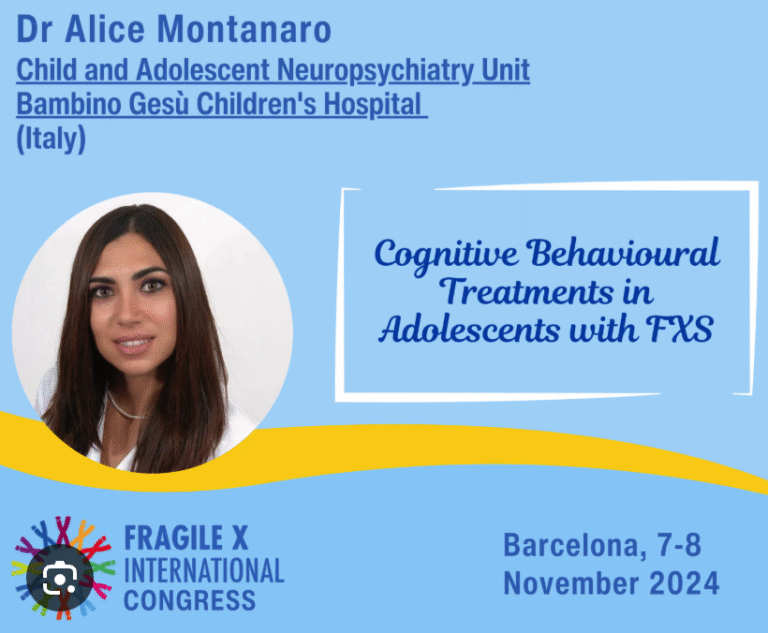
  • Dra. Alice Montanaro

    "Cuando la vida se vuelve más exigente": Un enfoque multiintegrado para toda la vida en la prestación de Terapia Neuropsicológica-Cognitivo-Conductual a adultos jóvenes que viven con FXS.

  • Dos niños con FXS

    Las alegrías del síndrome del cromosoma X frágil: se ha publicado un artículo

Este sitio web se traduce automáticamente mediante IA. Si detecta un error de traducción, por favor Contacto.

Tu apoyo puede marcar la diferencia.

Si prefieres donar por transferencia bancaria, nuestros datos bancarios son los siguientes: Fragile X International aisbl
IBAN: BE14 3631 4543 6483
BIC: BBRUBEBB

Donar ahora

X frágil internacional

Celebrar y apoyar a quienes viven con el síndrome del cromosoma X frágil y las enfermedades asociadas a la premutación del cromosoma X frágil en todo el mundo.

  • Fragile X International aisbl - FraXI
  • Rue d'Egmont, 11 - 1000 Bruselas - Bélgica
  • [email protected]
  • RPM Bruselas 0776.532.015
Visit Fragile X International on Facebook
Visit Fragile X International on LinkedIn
Visit Fragile X International on Instagram
Visit Fragile X International on TikTok
Logotipo de Rare Diseases International
Logotipo de Rare Diseases Europe

Únase a nuestra lista de correo

Introduzca su correo electrónico y reciba nuestras últimas actualizaciones. Al compartir tu correo electrónico, aceptas nuestra política de privacidad.

Política de privacidad | Mapa del sitio