
- Zprávy
- |
- Výzkum
“Transparent, collaborative, and hopeful”: Postdoctoral Researcher Kayla Smith on the world of FXS research
Published: 13 Bře 2026
Very often, FraXI comes across many driven researchers who have dedicated their lives to understanding Fragile X Syndrome. We want people living with FXS to know that among these researchers, there is a growing cohort of individuals who are putting the FXS community and their families at the heart of their work. We spoke with Dr Kayla Smith, a postdoctoral researcher at the University of Birmingham on her PhD journey and involvement in FXS research.
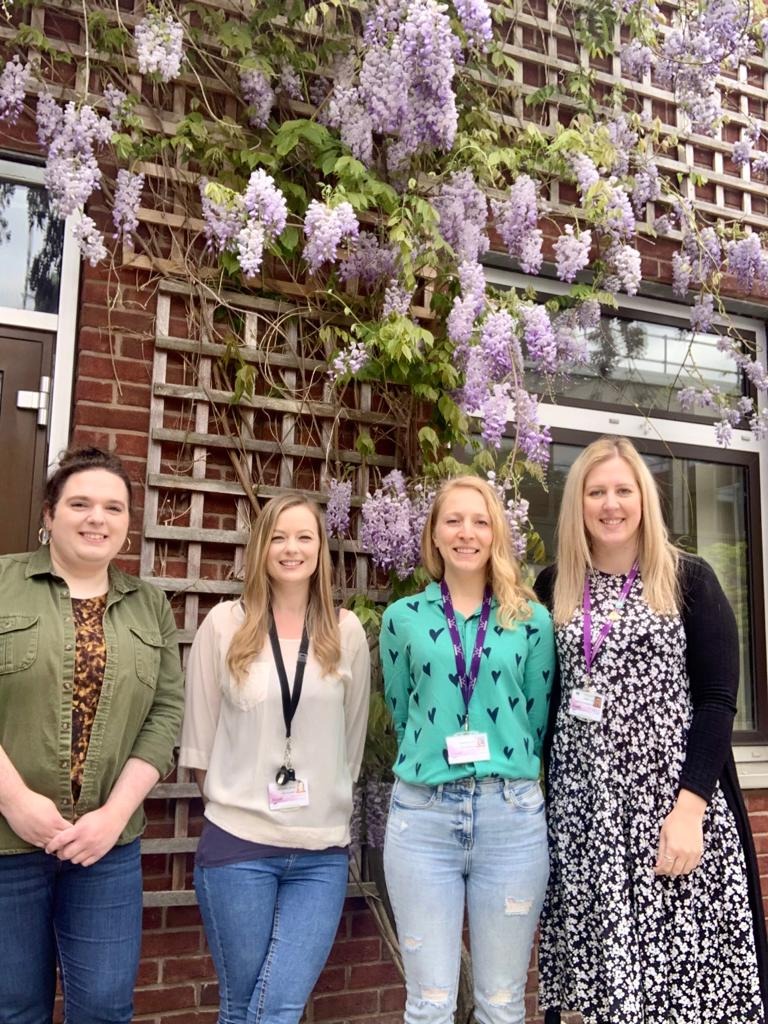
Kayla (far left) with her research team at the University of Warwick where she completed her PhD
Hello, Kayla! On behalf of the FraXI family, thank you very much for agreeing to chat with us today! Can you let us know a bit about your background?
I grew up in South Carolina, and I have always been interested in understanding how people think, feel, and connect with others. That curiosity eventually led me to study both biology and psychology, because I feel that it is important to understand how the mind and body work together.
This interest eventually resulted in me pursuing a PhD at the University of Warwick with Dr Hayley Crawford, which focused on understanding social experiences for people with fragile X syndrome. In very simple terms, I was interested in exploring different ways people with FXS may show that they’re anxious. Additionally, many people with fragile X syndrome often show a desire to engage with others (referred to as ‘social motivation’). I wanted to know more about how people with fragile X syndrome experience social anxiety and social motivation.
A big part of my work looked at things like heart rate and attention. This is because our bodies often give us clues about how we’re feeling, even if we can’t put these feelings into words. The more we know about how to measure social anxiety in people with FXS, the better we can approach support and interventions.
What drove you towards researching Fragile X Syndrome? Tell us what it was like when you first heard the words “Fragile X Syndrome” and the fascination that followed from there?
The first time I heard the words “fragile X syndrome,” I remember feeling curious and surprised that I hadn’t heard about the syndrome before. As I began working with Dr Jane Roberts at the University of South Carolina, I was struck by how complex fragile X syndrome is, including the challenges, the strengths, and the individuality of each person. While working with Dr Roberts, I learned about fragile X syndrome during infancy, which led to my PhD work focusing on fragile X syndrome during childhood and adulthood, giving me a better understanding of fragile X across a wider range of ages.
But what really drew me to researching fragile X syndrome wasn’t just the science; it was families. I remember attending a conference where a mom of a boy with fragile X spoke about her child’s experience with anxiety. Despite the challenges her and her son faced, the thing I remember most was the love she has for her son and her desire for him to experience life with less anxiety. The more I listened to parents and carers, the more I realised how much expertise, resilience, and love there is within this community. It felt very clear to me that research should be working with the families to tackle challenges such as anxiety while highlighting the strengths of people with fragile X syndrome.
I think the combination of interesting science and the incredible families is what made me want to stay in this field.
You are part of the Cerebra Network! Can you tell us what it is and why it was established?
The Cerebra Network is a UK-based research network funded by Cerebra that shares knowledge, expertise and resources across four leading institutions (University of Warwick, Aston University, University of Surrey, and University of Birmingham) to deliver greater insight into people with rare and complex syndromes, such as fragile X syndrome.
The Cerebra Network was established to encourage collaboration. This allows researchers to work together to share ideas, methods, and findings across a large area of research, including autism, mental health, sleep, and behaviours that challenge. One of the most important things about the Cerebra Network is that it puts families at the heart of research, helping to make sure that the questions we ask are the ones that actually matter in everyday life.
What is your role within the Cerebra Network and how does it relate to your research?
Within the Cerebra Network, I started as a PhD student at the University of Warwick, and now I am a postdoctoral researcher at the University of Birmingham. I work as part of a larger group of researchers focused on improving outcomes for people with neurodevelopmental conditions, like fragile X syndrome, and their families. For me, the Cerebra Network is a space to share my work on anxiety and heart rate, learn from others studying different areas of development, and think about how our findings connect. Being a part of the Cerebra Network also helps with bigger-picture thinking, which really strengthens my research and the support we can provide.
How has being part of this network positively impacted your PhD and your life in general?
The Cerebra Network has given me access to brilliant and supportive mentors. PhDs can sometimes feel overwhelming and isolating, so being a part of a network reminds you that you’re a part of something bigger.
It is also really inspiring to learn from other people who have similar interests and motivations as I do, even if their research interests aren’t exactly the same as mine. When you see how many researchers genuinely care about improving outcomes for families, it reinforces why the work matters. The Cerebra Network has also helped me grow in confidence, whether it’s sharing ideas, getting feedback, or learning how to communicate research in different ways to make science and research more accessible and meaningful for everyone.
It’s also been incredibly rewarding. Throughout my time so far, I’ve gotten to speak with families and hear their experiences, which has helped me realise how the work I’m doing is relevant to families. It has been especially rewarding to help translate the work we do as a network into practical and free resources, such as the Cerebra parent guides. Research shouldn’t just live in academic journals but should come back to families in a way that feels useful, accessible, and supportive.
What would you say are the most rewarding aspects of researching FXS? We imagine there might be many!
Without question, the most rewarding part of researching fragile X syndrome is meeting families. There is something very powerful about knowing that the data you collect represents real children, real adults, real families, and real experiences. It is incredibly meaningful when a person with fragile X or their parent tells you they feel seen or understood.
It is also rewarding to see small pieces of the puzzle come together, such as understanding anxiety a bit better, seeing patterns, or spotting strengths that might previously have been overlooked.
If you could share a message with an individual living with FXS or a parent/carer reading this interview, what would it be?
I would say that your experiences matter more than you know. Research is strongest when it listens to the people it impacts the most. The questions I ask, and the research that I want to be a part of, are shaped by people with fragile X syndrome and their families. Your insights are not “extra,” they are essential.
And to people living with fragile X syndrome, you are not defined by a diagnosis. Research exists to better understand how to support you, but your personality, humour, interests, and strengths are always more important than any label.
What would you like to see more of in FXS research?
Along the lines of the Cerebra Network, I would love to see even more collaboration across countries, across disciplines, and especially between researchers and families.
There is a lot of work that still needs to be done in fragile X research. So far, research has really focused on “snapshots,” so we need to do more work to understand how people with fragile X develop over time. I’d also like to see more research on anxiety, but also how this anxiety work can be translated into something more practical, such as interventions or treatments specifically designed for people with fragile X syndrome.
While research on anxiety is really important, I would also really like to see more strengths-based research, such as understanding not only challenges, but motivations, interests, and resilience. Ultimately, I would love for fragile X research to feel more transparent, collaborative, and hopeful.

