
- Genetics Overview
- The Fragile X Gene, FMR1
- Fragile X Syndrome and the FMR1 Full Mutation
- The FMR1 Premutation
- The FMR1 Intermediate (Grey Zone) Result
- Mosaicism
- Ressourcer
Genetics Overview
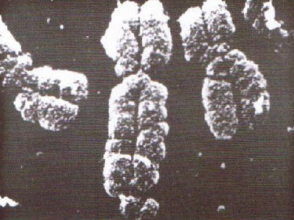
Our genetic information is contained in genes, which are instructions for how to make the many proteins that are needed to build the human body, and to keep it functioning. Humans have about 23,000 genes, which are packaged into 23 pairs of chromosomes. The first 22 pairs are numbers from 1-22 and the 23rd pair are the sex chromosomes, typically XX in females and XY in males. Half of the chromosomes are inherited from the mother and the other half from the father.
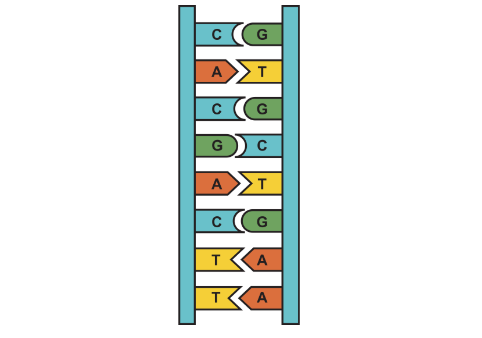
The genetic code is carried by a chemical called DNA (deoxyribonucleic acid). DNA is made from building block-like structures called ‘bases’. The four bases that make up DNA are Adenine, Thymine, Cytosine and Guanine, better known by the letters A, T, C, and G. These bases pair up with each other (A with T, C with G) to make a ladder-like structure (see image below).
The Fragile X Gene, FMR1
Fragile X is associated with changes to a gene that is located on the X-chromosome called FMR1 (Fragile X Messenger Ribonucleoprotein 1). The FMR1 gene contains the instruction for making a protein called FMRP (FMR1 protein), which plays an important role in the development and function of the brain. Everyone has the FMR1 gene but it is altered in people with Fragile X Syndrome (FXS) and its premutation associated conditions (FXPAC).
The most important change that occurs in the FMR1 gene is related to a stretch of DNA that sits next to the gene and contains the repetition of three bases, ‘CGG’. Most people have fewer than 45 CGGs, and more than 45 CGGs is considered an increased number.
| Number of CGG repeats | Outcome |
|---|---|
| Fewer than 45 | Unaffected |
| 45-55 | Intermediate/Grey Zone |
| 55-200 | Fragile X Premutation |
| More than 200 | Fragilt X-syndrom |
FXS is diagnosed by genetic testing on blood drawn from an individual. Please see a health professional for testing. You can start by visiting a pediatrician, family doctor, or genetics clinic. FraXI has its own list of clinics.
Fragile X Syndrome and the FMR1 Full Mutation
A number of CGGs in excess of 200 is called a ‘full mutation’. Full mutation causes a chemical change to the DNA called ‘methylation’ that turns off FMR1 and the production of FMRP. Reduced or absent production of FMRP results in Fragile X Syndrome (FXS).
Boys and men only have one X chromosome and therefore only one FMR1 gene. This means that when their FMR1 gene is turned off, their cells produce very little FMRP which causes Fragile X symptoms.
Girls and women have two X chromosomes and therefore have copies of the FMR1 gene. This means that girls and women who have a full mutation on one copy of FMR1 also have a second normal copy of the FMR1 gene that can produce FMRP. In each cell, the choice of which FMR1 gene the cell uses is seemingly random. This variability means that girls and women can show different symptoms of FXS to those seen in boys and men. There is more extensive information available on Fragile X Syndrome as a whole.
The FMR1 Premutation
If the number of CGGs is between 55 and 200, this is known as a Fragile X ‘premutation’.
The first important characteristic of premutations is that they can expand to become full mutations when transmitted from a mother to a child. The chance of this occurring varies according to the size of the premutation — small premutations (e.g. between 55-60 CGGs) very rarely expand to full mutations when transmitted; on the other hand, premutations of >100 CGGs nearly always expand to a full mutation when passed on.
In general, the higher the number of CGG repeats in the premutation, the greater the chance it becomes a full mutation when passed from a mother to her child. When the premutation is passed from the father to his children it shrinks in size, so regardless of its size in the father it is highly unlikely to become a full mutation and cause FXS when passed on from a father to his child. More information is available about how each gene is passed on.
The second characteristic of premutations is that people who carry them are at higher chance of developing certain health conditions. These health issues are different from those that occur in FXS and are referred to as Fragile X Premutation Associated Conditions (FXPAC). All of the health issues associated with the premutation are variable and do not affect all people who have premutations — in particular, the chance of these issues occurring appears to be low in people with fewer than 65 CGG repeats.
Researchers have identified some other health issues that may be more common in people with the Fragile X premutation than the general population, but more research is required to understand these associations.
The FMR1 Intermediate (Grey Zone) Result
When the number of CGGs is between 45 and 55, this is called an intermediate or ‘grey zone’ result. This result is quite common, occurring in about 1 in 50 people. People with grey zone results typically do not have any symptoms. The main aspect of grey zone results is that there is a small chance that a grey zone result can expand to a premutation result when passed from a parent to a child. Someone with a grey zone result is not likely to have a child with FXS.
Mosaicism
Mosaicism occurs when an individual with Fragile X Syndrome (FXS) has different variations of CGG repeats. Individuals with mosaic FXS tend to have fewer symptoms and may require less support than people with the full alteration, though this is different for every person.
Some people with expanded FMR1 genes have different CGG sizes in different cells in their body. This is called CGG ‘size mosaicism’. Most commonly, size mosaicism involves a mixture of some cells that have a full mutation and some cells with a premutation.
There is also a second type of mosaicism in FXS, called ‘methylation mosaicism’. As noted above, methylation is the process by which a Fragile X full mutation causes the FMR1 gene to be switched off. Sometimes this methylation is incomplete, such that the FMR1 gene remains partly active.
Modern testing can identify mosaicism in ways that previously were not possible. For adults diagnosed with FXS who appear less affected by symptoms or have a higher IQ, retesting may identify mosaicism.
Ressourcer
There is more information available on Fragile X Syndrome and Genetics.

