
- පවුලේ කතා
- |
- පුවත්
Rare but Real: A family’s story of myths, stigma, and Fragile X Syndrome
Published: 27 මාර්තු 2026
For doctors Paulin Madia and Ruth Kabengele, diagnosing patients is part of their job. But when the time came for them to go on their own diagnostic journey with their sons, who both live with Fragile X Syndrome, it was not the diagnosis that was their biggest challenge, but what came afterwards. We are grateful to Paulin and Ruth (and FraXI’s Vice President, Kristin Mulcock, for supporting them with sharing their story and translating) for taking the time to chat with us.
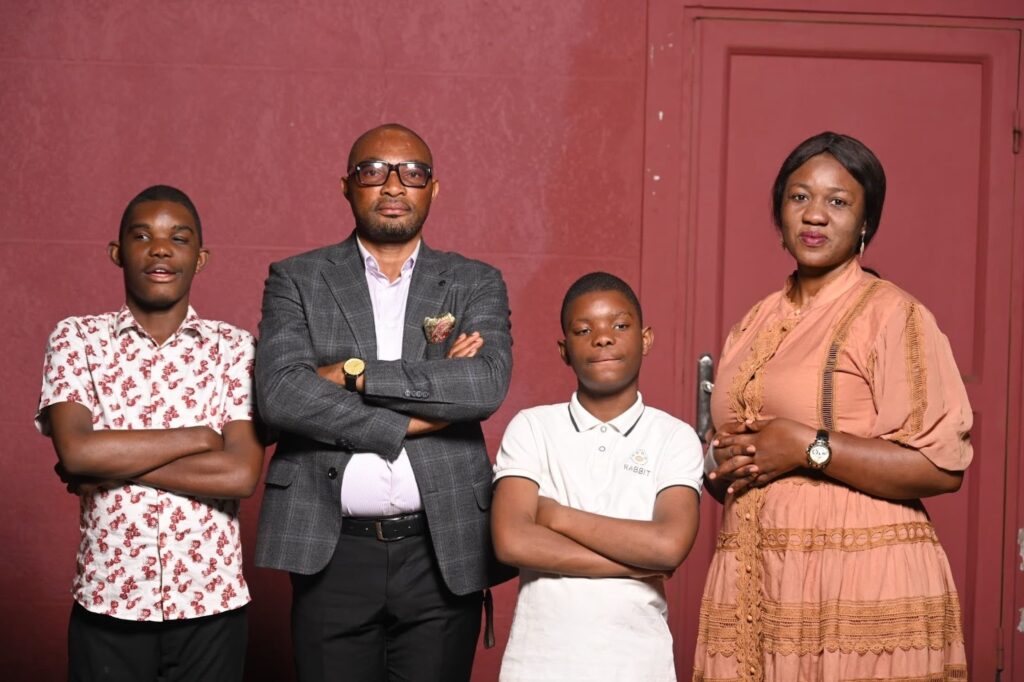
Almost a decade ago in Lubumbashi, Democratic Republic of the Congo, Paulin and Ruth began to notice that their sons were not developing at the same pace as the children of their friends. Their older boy began to walk and talk much later than other kids and the younger showed symptoms of a heart condition. This prompted them to consult a psychiatrist, a neurologist and eventually a geneticist, but none of them could identify the cause. However, they all agreed on one thing- there was a developmental difference in both boys.
When their sons were 4 and 1 years old, Paulin and Ruth moved to South Africa in search of answers. At Georges Mukhari University Hospital in Pretoria (Garakhua), they were told that their boys had Coffin Lawry syndrome, but the truth only emerged after blood samples taken at VET Johannesburg were sent to a laboratory in London for analysis: the boys were diagnosed with a condition called Fragile X Syndrome (FXS).
“At first, we were relieved because we knew that our sons’ condition had a name,” says Paulin. “Even though we are both doctors, we had never heard of FXS before. Our medical backgrounds helped us to accept that this was real, and we were guided to the correct places to research FXS. For a long time, we knew that our boys were different. It took a very long time to learn why, but by that time we had already accepted that there was something causing them to be different. We just didn’t know what.”
But putting a name to the face of the condition was only one piece of the puzzle for Paulin and Ruth. Beyond the walls of their home in Lubumbashi is a world that is far from kind to them and their boys. “The DRC does not have the facilities or availability of specialists that are needed to provide therapies and interventions to people with FXS,” says Ruth. “Our sons are always either pushed under the autism umbrella or labelled as kids with ‘special needs’”.
These labels are penalising. The family faces discrimination and stigma from other parents, teachers, children, and even random strangers. “There are cultural reasons for the challenges we are going through,” says Paulin. “Most people think our family is part of a cult and that our boys are cursed. Some think that they are different because of witchcraft. Parents keep their children away from ours because they think that they are contagious, and that their own kids will also be infected with their condition. Our boys are never invited to parties because of this.”
Paulin and Ruth battle situations like this every single day. “The other day, I took one of our sons to the hairdresser. He refused to cut my boy’s hair. We were asked to come back when no other customers were around. I wanted to ask the hairdresser why he was treating us differently, but I was scared. So I remained silent.”
“A lot of people also blame us for making our sons ‘sick’”, adds Ruth. “Everywhere we go, we get stared at. People judge us and avoid us.”
Despite these difficulties, Paulin and Ruth are raising their boys fearlessly. They have no intention of hiding their children, and have enrolled them in a school that provides a specialised curriculum for students with intellectual disabilities. “We have to pay an extra fee because their teachers have to give them more attention,” says Paulin. “It is expensive, but we manage. But there are so many families in the DRC who cannot afford this type of education.”
Paulin and Ruth want the world to know that they only want one thing to be certain in their boys’ future—that they will be independent. “We are caring for them and raising them so that when we are gone, they can look after themselves. We want them to educate themselves and socialise just like other kids. They do face bullying in school, but there are a few that are empathetic. We hope that the world will be kinder to them”, says Paulin.
“We are proud of our boys!” says Ruth. “Our oldest is going to be sixteen soon. He loves music and plays the guitar and drums. Our younger son is fascinated with technology, especially cars. He also loves playing with buttons—if he sees a button, he will push it!”
We asked Paulin and Ruth to tell us about what raising their boys has taught them about life, love, and care. They both agree that their outlook on life has changed—they understand that anything can happen at any given moment, but eventually we must accept it and take responsibility to keep going. “We realised that we had nothing to feel guilty about—we could not control how our boys were born. But we can control how our boys are raised,” they tell us. “You have to live your life without paying attention to what people think. We love our boys. That is what matters.”
Paulin and Ruth light up whenever they get to talk about their sons. “If there is anything contagious about them, it’s their joy and enthusiasm for life.” Navigating FXS involved a lot of independent research into rare conditions for Ruth and Paulin. They now understand that families like theirs are connected by love, endurance and perseverance. While caring for their sons, Paulin and Ruth also volunteer to help families like theirs who are less able to help themselves. Educating themselves about FXS has prompted them to search for more families that share the gene and pass on their knowledge.
But what is truly inspiring is that Paulin and Ruth are not the only ‘teachers’ in this equation. According to them, they are learning every day from their sons. Before they were born, Paulin and Ruth knew the phrase “love thy neighbour as thyself” as a principle of faith. They only discovered the true meaning of it because of their boys. “Our sons are our blessing,” says Ruth. “I think there is a capacity to show love and empathy for each other in every single person, but it is buried deep within us. Our children awakened that in me and Paulin. Because of them we have found it so easy to be kind and understanding when someone is going through a hard time. Without them we would not know love, or how easy it is to show that you care.”
දුර්ලභ රෝගයකින් පෙළෙන අයට සහ ඔවුන්ගේ පවුල්වලට උපකාර කිරීම සඳහා EURORDIS විසින් සම්පතක් සකස් කර ඇත. කරුණාකර බලන්න මානසික සෞඛ්ය සම්පන්න මෙවලම් කට්ටලය ඔබව රැකබලා ගන්නේ කෙසේද යන්න පිළිබඳ සම්පත් සඳහා. ඔබේ රටේ බිඳෙන සුළු x සහාය කණ්ඩායමක් නොමැති නම්, කරුණාකර FraXI වෙත සම්බන්ධ වන්න අපිට එකක් පටන් ගන්න උදව් කරන්න පුළුවන්.

