
Understanding Sensory Systems
Sensory systems are the parts of the brain and body which allow information to be detected and interpreted from the environment. Each sensory system has specialised body parts which collect information about the environment and send it to the brain. The information which is processed includes light, sound, temperature and touch, but this list is not exhaustive. The main sensory systems are visual, auditory, tactile, olfactory and gustatory, but there are also vestibular, proprioception, thermoception and interoception sensory systems.
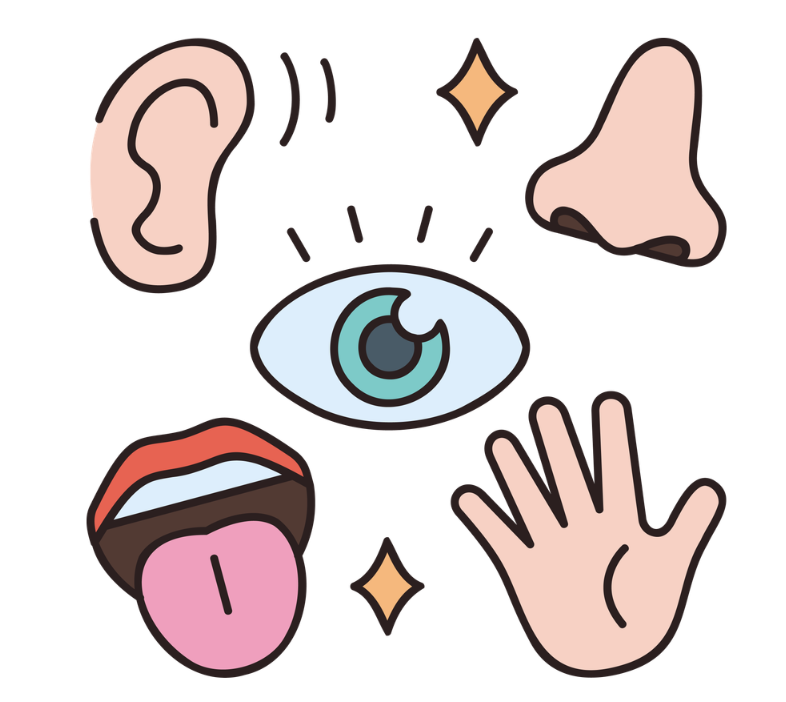
People with Fragile X Syndrome (FXS) may be more sensitive (hypersensitive) or less sensitive (hyposensitive) to what they experience in their environment. This can lead to a person either becoming overwhelmed or unfulfilled by their environment. Within one individual they may be hypersensitive to some things while also being hyposensitive to others. Sometimes sensory processing difficulties can impact behaviours. This is covered more extensively in the section on ‘Behaviour and Therapies‘.
Visual: The visual sensory system is what our sense of sight relies on. It involves the use of the eyes to see light, colour and motion. Some people may enjoy looking at colours and lights while others may find normal levels of light too bright. Additionally some people may learn and take in new information best through visual methods like looking at pictures.
Auditory: The auditory sensory system allows us to hear things in our surroundings. It involves the use of our ears to transport sound information to the brain. Some people may enjoy listening to loud music, while others may find day-to-day noises around them to be too much. Some people may learn and understand best from information being told to them.
Tactile: The tactile (touch) sensory system allows us to feel our surroundings. It can react to touch, temperature, pain and vibration. Most of the information is taken in through the skin. Some people may be averse to touch while others may find enjoyment and comfort in deep pressure. Additionally some individuals will learn best by doing things which are practical in comparison to other methods of learning.
Olfactory: The olfactory sensory system is responsible for our sense of smell. Chemicals in the environment are detected by the nose which takes the information to the brain. Some people find certain scents calming, while others may find them overwhelming. For those who are sensory seekers they may enjoy learning about the world through smells.
Gustatory: The gustatory system is how we taste the things we eat and drink. The taste buds on the tongue communicate with the brain to understand how things taste. People with FXS may be more sensitive to taste, texture and temperature of food. Some individuals may prefer food which has a consistent texture, such as bread or crackers, rather than fruits which may have a different texture from one fruit to the next. Additionally they may prefer food which is plain and has a less strong taste.
Proprioception: Proprioception is the body’s ability to know its own position and movements. The body has special receptors in the muscles, tendons and joints to be able to detect position, movement, pressure and speed. People with FXS are commonly under-responsive to proprioception. This can cause them to accidentally use too much force for activities, constantly crave movement, and be clumsy or bump into things in their surroundings. More on therapies to assist with proprioception can be found in the section on ‘Physical Therapy’.
Thermoception: Thermoception is the sensory system responsible for sensing temperature. Cold receptors respond to cool temperatures and heat receptors respond to warm temperatures. Some people may be over responsive to temperature and others may be under responsive.
Interoception: Interoception is the brain’s ability to interpret signals from inside the body. This includes hunger, thirst, needing the bathroom, pain and emotional sensations. People with FXS are more likely to struggle with interoception and understanding their body’s needs.
Hypersensitive
People with FXS often have heightened sensitivity to sensory input (hypersensitivity) which can lead them to becoming overwhelmed by things in their environment which many people’s brains automatically block out. This sense of overwhelm can have an impact on a person’s day-to-day life, including their συμπεριφορά. The cause of the person becoming overwhelmed will determine how to help to manage the situation. There are techniques and aids available for each sensory system to reduce sensory input to prevent a person becoming overwhelmed. Those listed here are not exhaustive and every individual will have different needs. Sometimes solutions may require creativity to problem solve. It is worth noting that prolonged reduction of sensory stimuli may lead to a person becoming more sensitive when exposed to triggering stimuli, therefore any aids to lessen sensory input should be discussed with a professional.
Visual: Using softer lights in a person’s day-to-day environment can help to reduce visual stimulation for those who are visually sensitive. Additionally the use of sunglasses when bright lights are unavoidable may be useful.
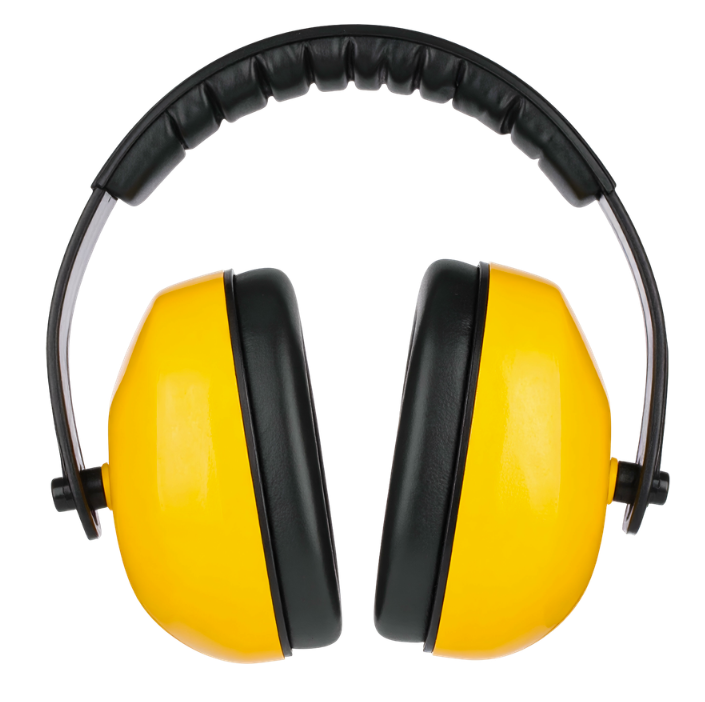
Auditory: Ear plugs or ear defenders can be used to dampen noise, however they may not be suitable for everyone with auditory sensitivities as they can amplify the body’s internal sounds (occlusion). Some people may find white noise or nature sounds helpful to calm themselves.
Tactile: Some people with FXS may find tactile input overwhelming and be avoidant to physical contact. It is important to respect their wishes and autonomy in day-to-day life, though this may not be applicable in emergencies. There is more about this in the section on ‘Autonomy’. Individuals may be more sensitive to tactile stimuli such as clothing tags or certain fabrics. There are certain companies which make clothing without labels and with flattened seams for people with sensory sensitivities, though these can be expensive.
Olfactory: Assisting someone who is hypersensitive to smells is less easy than other senses, however using unscented products can help to lessen the likelihood of a person becoming overwhelmed. Additionally, requesting that those who come into contact with the person with sensitivities avoids strong perfumes may help. Some people may find that having access to a scent which they enjoy will help to mask scents which are triggering. For example, this could be something like a scented lip balm.
Gustatory: Many people with FXS may have sensory aversions to a variety of foods. This can make it difficult to ensure a person is getting adequate nutrition. Some people will react strongly to taste, some to texture and some to both taste and texture. Supporting an individual hypersensitive to gustatory stimuli can include offering mild tasting foods, offering their preferred food alongside any new foods, allowing the person some freedoms over food choices where appropriate, using desensitisation if they are ready and keeping foods separate from each other when serving.
People with particularly restricted diets may need intervention from a health professional if nutritional deficiencies are present or maintaining weight is a challenge. Some people with FXS may also have Avoidant Restrictive Food Intake Disorder (ARFID). If you think your loved one may be suffering from ARFID it is important to seek professional help. There is additional information available on Avoidant Restrictive Food Intake Disorder.
Please see this Case Study for a Hypersensitive Child.
Hyposensitive
In some cases an individual may have a reduced sensitivity to sensory input (hyposensitivity). This can appear as them being bored and may lead them to seek out sensory experiences, or display unwanted behaviours. There are techniques and aids available to assist with understimulation. Those listed here are suggested ideas and may not work for every individual.
Visual: Using sensory lights and/or projectors can be a good way of keeping a sensory seeker engaged in a way that does not necessarily exert any physical energy. These tools often have lots of colours which can be a good way of grounding someone and can be paired with colour naming activities to engage focus. Marble mazes can be useful as an activity which is more on the practical side but not necessarily overstimulating. Additionally, colouring sheets are a good way of pairing fine motor skills practice with a visually engaging activity. Many free online resources are available for colouring sheets.
Auditory: Individuals who are seeking auditory input may come across as loud. They are often drawn to making their own sounds either verbally, with objects or both. A good way to engage people who are hyposensitive to sounds is to give them space to make noise. This could be through listening to music or giving them access to a musical instrument/percussion instrument.
Tactile: Messy play such as that involving slime or foam can be a good way to keep hyposensitive individuals engaged. In environments where this may be difficult to facilitate fidget toys provide a good alternative. Fidget toys come in lots of shapes, colours and sizes so trying out a few may help to find ones which provide the desired tactile input for your loved one.

Olfactory: For individuals who are hyposensitive to olfactory stimuli it can be helpful for them to play scent based guessing games or using products which have strong scents. Similar to people who are hypersensitive to olfactory stimuli, individuals may benefit from having access to a preferred scent such as that of a lip balm or similar.
Gustatory: Chew toys are a good way of getting gustatory input. They come in a range of textures and firmness. Additional information is available on biting and chewing. Taste tests and new food introduction is a good way to increase the amount of gustatory input an individual is experiencing. Offering a variety of textures such as soft, crunchy and chewy may be of interest to your loved one.
Please see this Case Study for a Hyposensitive Child.
Sensory Diets
A ‘sensory diet’ refers to a custom made plan of activities and tools designed to help an individual feel comfortable in themself and their environment. This can be helpful for people with sensory processing difficulties, such as those common in people with Fragile X Syndrome (FXS).
A sensory diet can be used for people who are seeking sensory input, displaying sensory avoidance, or a mixture of both. Signs that a person is seeking sensory input include engaging in rough play, fidgeting, difficulty focusing and appearing tired. Signs that a person may be overwhelmed by sensory stimulation include dislike of certain textures, avoidance of certain environments and difficulties with self regulation.
Putting together a sensory diet can include a schedule which could be used at home or external settings, such as at school. This might include sensory stimulatory activities in the morning for a person who is prone to disruptive behaviour, or a calming morning routine to prepare for a change of activity for those who are more sensory avoidant.
A sensory diet could also consist of putting together a list of activities which you know to be beneficial for your loved one and allowing them to choose an activity to assist in regulating themself. More information on activity choosing can be found in our resource on Δραστηριότητες διαλείμματος κίνησης.
We have created our own resource on example sensory diets.

